
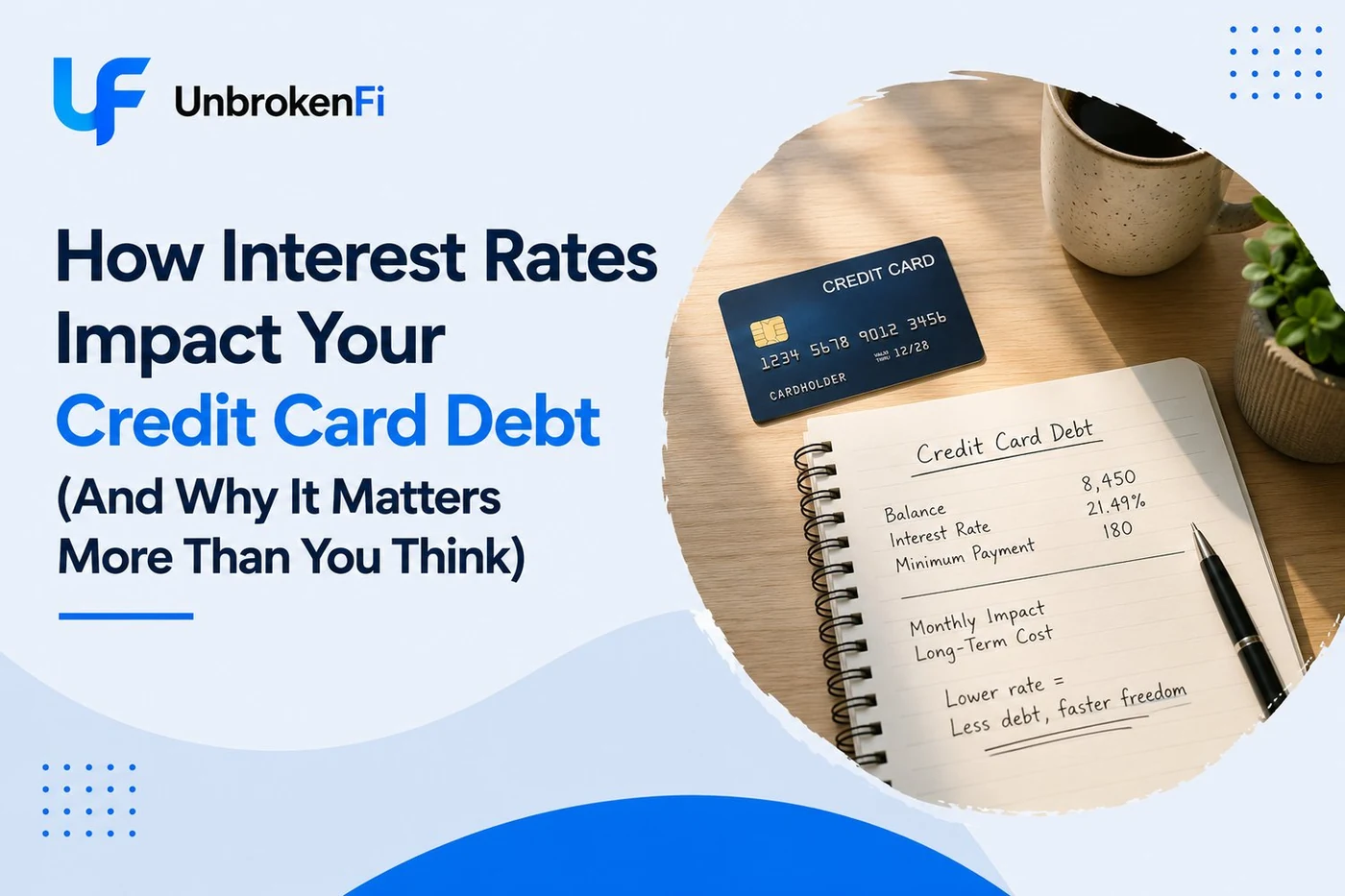
You've probably seen the interest rate on your credit card statement before. But what does that really mean, and does it really matter if you can afford your monthly payment?
It matters a lot more than most people realize, and understanding how it works could save you a significant amount of money.
What’s Covered
- What Is a Credit Card Interest Rate?
- How Carrying a Balance Works
- The Cost of Only Paying the Minimum
- How Your Rate Is Determined
- What Happens When Rates Rise
- How to Protect Yourself
- The Bottom Line
1. What Is a Credit Card Interest Rate?
Your credit card interest rate is expressed as an APR, or Annual Percentage Rate. It's the percentage of your balance the card issuer charges you each year for carrying debt.
But credit card interest isn't calculated once a year. It's calculated daily. Your APR gets divided by 365 to get a daily rate, and that rate gets applied to your balance every single day.
Here's what that looks like in practice:
- APR of 24 percent = a daily rate of roughly 0.066 percent.
- On a $3,000 balance, that's around $60 in interest added to what you owe, in just one month.
- That's $60 added before you've spent another dollar.
- On a $90 minimum payment, roughly two thirds is going toward interest. Only about one third is actually reducing your balance.
2. How Carrying a Balance Works
Most credit cards offer a grace period, which is the window between the end of your billing cycle and your payment due date.
Here's what that looks like in practice:
- June 1 - June 30: Purchases of $2,500 made
- July 1: Your statement closes with a balance of $2,500
- July 23: Your due date
- Pay the full $2,500 for June's purchases by July 23 and you owe zero interest
If your previous statement balance was paid in full by the due date, or was zero, you won't be charged interest on new purchases in the next billing cycle. This is how the grace period is meant to work.
Here's where it gets a little more nuanced though: if you carried a balance beyond the due date at any point and then paid it off after, the grace period doesn't automatically snap back right away.
Here's what that looks like in practice:
- May 31: Statement closes at $2,500. You pay $1,500, carrying $1,000 into the next cycle.
- June 1 - June 30: Interest accrues daily on the $1,000. You make $800 in new purchases. Those new purchases lose the grace period and accrue interest immediately too.
- July 1: Statement closes. You owe the $1,800 balance plus interest on all of it.
- July 23: You pay the full statement balance.
- August statement: You still see interest charges from the days the $1,800 was carried before your payment posted.
- To fully restore the grace period, your August statement balance also needs to be paid in full by the due date.
3. The Cost of Only Paying the Minimum
Credit card issuers are required to show you a minimum payment on every statement. It's usually a small flat amount or a small percentage of your balance, whichever is higher. It feels manageable. That's by design.
Here's what the math actually looks like:
- $3,000 balance, 24 percent APR, $90 minimum payment
- Time to pay off: around 12.5 years
- Total interest paid: thousands of dollars on top of what you originally spent.
This is assuming you never use the card again.
Paying just a little more than the minimum each month makes a dramatic difference. In many cases, doubling your minimum payment can cut your payoff time and total interest by more than half.
4. How Your Rate Is Determined
Credit card interest rates aren't random. They're tied to a few key factors.
- Your credit score. The higher your score, the lower the rate you're typically offered. Lenders see a strong credit history as less of a risk, so they charge you less for it.
- The prime rate. Most variable rate credit cards are tied to the federal prime rate, which moves based on decisions made by the Federal Reserve. When the Fed raises rates, your APR typically goes up too, even on existing balances.
- The type of card. Rewards and travel cards often carry higher APRs than basic cards. The perks have to be funded somewhere. If you're carrying a balance, a high-reward card can easily cost you more in interest than you're earning in rewards.
Pro Tip: If you're shopping for a lower rate, your local federal credit union is worth checking out. They often offer more competitive rates than traditional banks and lenders.
5. What Happens When Rates Rise
Because most credit card APRs are variable, they move with the market. When the Federal Reserve raises rates, credit card rates follow shortly after. This rate increase isn't negotiable.
This is why credit card debt can feel like quicksand during periods of rising interest rates. Your balance isn't growing because you're spending more. It's growing because the cost of carrying that balance increased.
Pro Tip: You can sometimes find a fixed rate credit card at a local federal credit union.
6. How to Protect Yourself
Low Risk
- Pay your full balance every month. This is the most effective thing you can do. A 24 percent APR doesn't matter if you never carry a balance.
- Call and ask for a lower rate. It doesn't always work, but it works more often than people think. If you've been a customer in good standing, a simple phone call asking for a rate reduction can sometimes result in one.
Medium Risk
- If you have to carry a balance, pay more than the minimum. Even an extra $20 or $30 above the minimum each month can shave months or years off your payoff timeline.
Higher Risk
- Look into a balance transfer. Some cards offer a zero percent introductory APR on balance transfers for a set period, sometimes 12 to 24 months. If you have a plan to pay off the debt within that window, this can be a smart move. Watch for transfer fees and know what the rate jumps to after the intro period ends.
One common pitfall: transferring the balance to a new card and then running the old one back up. Now you're dealing with twice the debt and two interest rates once the intro period expires. This only works if you're committed to paying it down and leaving the old card alone.
Pro Tip: Closing the old card will likely hurt your credit score, so I don't recommend it unless you're doubting your ability to stop using the card. But a temporary dip in your score is a lot easier to recover from than twice the debt.
7. The Bottom Line
Your credit card interest rate isn't just a number in the fine print. It's the thing that determines how much your debt actually costs you over time. A high rate on a carried balance can turn a manageable amount of spending into a multi-year financial burden.
The more clearly you understand how interest works, the better equipped you are to make decisions that keep it from working against you.
Let's unbreak your finances.
This post is for general informational purposes only and is not intended as financial or legal advice. Every situation is different. Consider speaking with a qualified financial professional about your specific circumstances.
← Back to Resources