
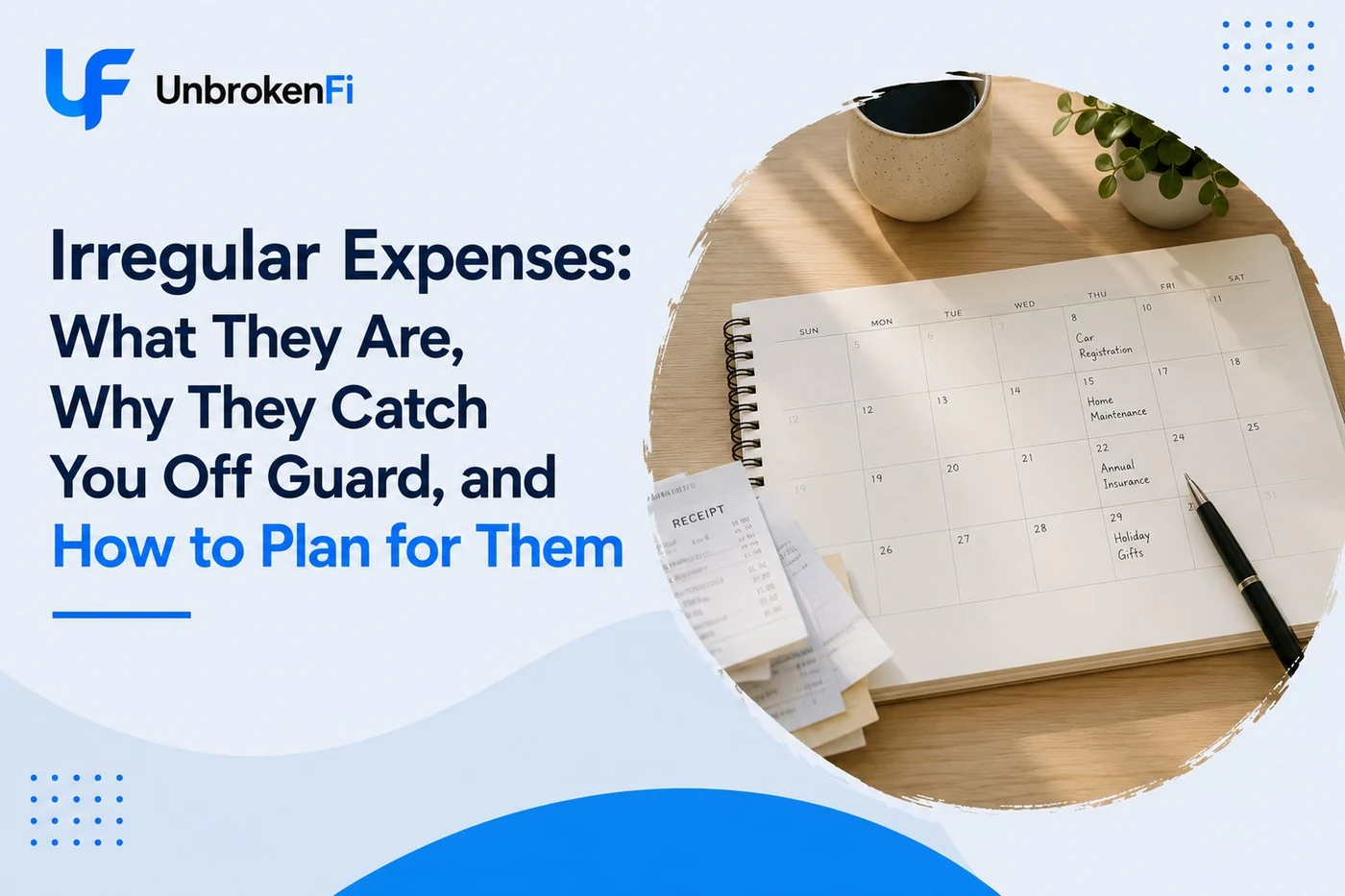
You've probably had this happen before, out of nowhere a bill shows up that you technically knew was coming up but didn't see coming. Car registration. A vet visit. Holiday gifts. A birthday dinner you couldn't get out of. An annual subscription that renewed without warning.
None of those are surprises in the true sense. You knew they existed. You just didn't have a plan for them. And that's the real problem.
What’s Covered
- What Irregular/Occasional Expenses Are
- Why They Catch People Off Guard
- How to Treat Them
- How to Save for Them
- Common Mistakes
- How to Stop Yourself From Dipping Into the Fund
- Tools to Help You Get Started
- The Bottom Line
1. What Irregular/Occasional Expenses Are
Irregular expenses are costs that don't come up on a fixed monthly schedule but are predictable enough that you can plan for them. They're not usually emergencies but they don't fit into your typical budget routine either.
Some common examples:
- Car registration and inspections
- Annual insurance premiums
- Holiday gifts and travel
- Birthdays and anniversaries
- Vet bills and pet care
- Home maintenance and repairs
- HVAC filter replacement
- Water filter replacement
- Pressure washing
- Pest control, etc.
- Back to school costs
- Quarterly, semi-annual, and annual subscriptions or memberships
- Discount clubs
- Streaming and AI services
- Subscribe and save product subscriptions, etc.
- Medical and dental co-pays
The thing these all have in common is that they're coming whether you're ready or not. The only variable is whether you have the money set aside when they arrive.
2. Why They Catch People Off Guard
Out of sight, out of mind: It's easy to mentally file it away and forget about it until it's too late.
Timing: Budgeting typically happens when payday comes around, or on a monthly schedule. While that's totally fine, these bills aren't usually considered there, although they really should be.
Optimism Factor: It's easy to tell yourself you'll have the money when the bill comes around or that you'll start saving for it later. Sometimes that's true. A lot of the time it isn't, and you end up scrambling, paying late, putting it on a credit card, or pulling from savings that were meant for something else.
3. How to Treat Them
The key mindset shift is this: stop treating irregular expenses as surprises and start treating them as scheduled costs.
A car registration that comes once a year isn't a surprise expense. It's a known cost that happens to be billed annually. The same goes for holiday spending, annual memberships, and most of the other things that tend to blindside people.
Once you reframe them that way, the solution becomes clear. If you know a cost is coming, you plan for it ahead of time instead of reacting to it when it arrives.
4. How to Save for Them
The most effective method is something called a sinking fund.
The concept: Set aside a calculated amount each month toward a specific future expense so that when the bill arrives, the money is already there.
Here's how to set one up:
Step 1: List every irregular expense you can think of for the next 12 months. Go through your calendar, your bank statements, apps on your phone, and your memory.
Step 2: Estimate the cost of each one. Be honest and a little generous with your estimates. It's better to have a little extra than to come up short.
Step 3: Divide each cost by the number of months until it's due. If car registration costs $200 and it's due in 8 months, you need to set aside $25 a month starting now. If you're paid bi-weekly, you could set aside $12.50 each paycheck. At that rate, it's not so overwhelming.
Step 4: Add all those monthly amounts together. That total is what you need to move into your sinking fund every month. It's part of your plan, just like rent or groceries.
Step 5: Keep it in a separate account. This is important. More on that in a moment.
5. Common Mistakes
- Underestimating the costs. Holiday spending is the classic example. People budget for gifts and forget about travel, food, decorations, and the random extras that always come up. Be realistic, not optimistic.
- Only saving for the expenses you remember. It's easy to remember the big obvious ones and miss the smaller ones that add up just as fast. Go through a year's worth of statements or search up your email for receipts or orders to prevent anything from going unnoticed. Once it's done, you'll just update it as you go routinely so it's easy.
- Lumping it all into one savings account. When irregular expense savings sit in the same account as your emergency fund or general savings, the lines blur. It starts to feel like one big pool of money and it becomes hard to know what's actually available. You'll want to have a detailed savings planner for this, or separate accounts; whichever makes the most sense for you.
- Starting too late. If a bill is three months away and you haven't saved anything yet, you're already behind. The earlier you start, the smaller the monthly contribution needs to be.
6. How to Stop Yourself From Dipping Into the Fund
This is the ultimate test of self control. Something comes up or you find something you really "need" and suddenly it feels like a reasonable exception. Then another exception happens. And another. By the time the original expense arrives, the fund is gone.
A few things that help:
- Keep it in a separate account, ideally at a different bank. Out of sight genuinely helps. When the money isn't sitting in the same app you check every day, it's easier to leave it alone.
- Label the account. Most banks and credit unions let you name savings accounts. Calling it "Car Registration and Annual Bills" makes it a little harder to justify pulling from it for something unrelated.
- Remember what the money is already for. When you're tempted to dip in, ask yourself what you're going to do when the bill comes due. If the answer is "I'll pay it back next week," be honest with yourself about whether that's realistic and whether you can actually afford it. Or if your answer is "put it on a credit card," that's a cost with interest attached. The fund exists to protect you from exactly that.
- Build a small buffer into your plan. If you know you have a tendency to dip into savings, add a small cushion to your monthly contribution. That way, if you do pull a little early, the fund can still cover what it needs to.
7. Tools to Help You Get Started
If you're looking for a place to start, UnbrokenFi's personal finance tools are built for exactly this kind of planning, from tracking irregular expenses to setting savings goals to planning every paycheck.
Browse the tools here.
8. The Bottom Line
Irregular expenses aren't the enemy. They're just costs that require a little more foresight than the ones that come every month. When you take the time to identify them, estimate them honestly, and save for them consistently, they stop being financial emergencies and start being taken care of.
The goal isn't to have more money. It's to make the money you have work smarter.
Let's unbreak your finances.
This post is for general informational purposes only and is not intended as financial advice. Every situation is different. Consider speaking with a qualified financial professional about your specific circumstances.
← Back to Resources